Will you vote for him if you see more of him?
Harold Wilson returns to the air in a BBC interview tonight. Will it help re-elect him?
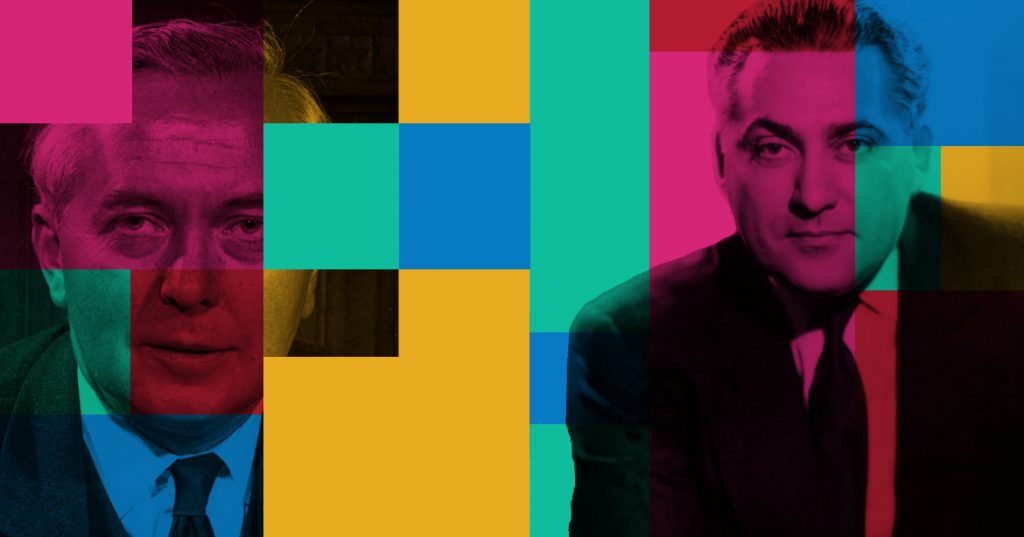
Tonight the Prime Minister will be appearing on a BBC programme [“Britain Today”, 9.55pm, BBC-1 – Ed] to discuss with Robert McKenzie for 40 minutes the state of the nation.
Although there seems nothing particularly revolutionary about such a programme, a BBC spokesman has hopefully described this mini-confrontation as “an attempt to find a new formula for political discussion at top level.”
Discerning observers of the political scene have already noted the sly and discreet way in which Mr. Harold Wilson is now beginning to use radio and TV to back himself into the limelight once again.
SAFE
Having spent almost the whole of 1968 out of reach of the electronic eye — even though such issues as the Enoch Powell racial speech, the Russian invasion of Czechoslovakia, the dock strike and the French riots were compelling reasons for a Prime Ministerial TV appearance — Mr. Wilson clearly feels that after so long a broadcasting sabbatical, it is electorally safe for him now to start polishing up his perhaps forgotten image.
He dipped a discreet toe into the broadcasting pool when he was interviewed on Radio 4 a couple of months ago reminding the listeners of his days as a Boy Scout and assuring them that he turned to God when he was in difficulty.
This picture of middle-class home-loving propriety and ordinariness — uncontaminated by the proximity of power and the temptations of authority — has been reinforced by Mrs. Wilson’s poetry, her reminiscences on Thames TV of her childhood as the daughter of a Congregational minister, and, last week, family photographs in Downing Street of a 21st birthday party for Mr. Wilson’s son.
Linked with this increasing display of pleasing domestic tranquillity is the sudden re-emergence of Mr. Wilson in the news programmes.
In the past week or so we have seen him mesmerising and dominating audiences in snatches of speeches he has given on such issues as the anti-Wilson plot and the proposed Industrial Disputes Act.
By coincidence or adroit management, he has always suceeded in getting into these news clips the most telling and dramatic bits of his speeches.
TRICK
The rest of these speeches, according to assessments of political journalists on the spot, never matched in quality these excerpts. It should be remembered that one of Mr. Wilson’s much admired TV tricks during his political campaigns was getting on the screen just the moment that was likely to do him the most good.
This reappearance of the old skill, the adroit master of the medium, must surely be giving heart to those optimists in the Party who still hope that Harold the Miracle Maker will once again lead them to the glorious mountain tops of electoral victory.
And it must be giving pause to those pessimists and plotters who can see only the ashes of defeat as their reward for sticking to their present leader.
There are, too, other reasons for believing — aside from his own personal appearances on the box — that Mr. Wilson has succeeded in setting the stage whereby TV can be used by his Party to convince the electorate of their right to another mandate
For almost three years now Mr. Wilson has manoeuvred and manipulated the control structure of the medium so that he is reasonably sure that — out at its lowest — TV will do nothing to block his Party’s chances for re-election.
Two astute politicians now run both the BBC and the ITA and under their aegis it is ensured that the rules of political balance will be played exactly as the politicians want it and that every need, every complaint, every desire of the major parties will be given sympathetic and considerate understanding.
You can be sure, too, that no political satire shows like That Was The Week or Not So Much A Programme will sully the air waves between now and the next election.
Last year BBC light entertainment producers were warned that there were to be no more Harold Wilson jokes on the box unless they were good. Since judging a good joke in such a context is a virtual impossibility, the Prime Minister has his visible flank reasonably covered.
Thus TV has been effectively castrated, neutralised or diminished in so far as it will be able to reflect any serious criticism of the Government’s past performance or record. The medium is the midget.
TEAM
How then can Wilson himself shine in such a bland, dehydrated, uninvolved, detached atmosphere? Much thought no doubt is now being given by the party propagandists to the brand new, saleable, cheap at any price product that Labour will be offering up to the electorate in the next few months.
We may see all sorts of things being tried. It is not going to be easy. The dynamic technocrat, the economic wizard, the national leader, the concerned defender of minorities, the man of courage, the comforting father figure, have all been used without much success.
Since he has always appeared alone in Ministerial and Party Political broadcasts, there is some talk about his being seen on telly as the leader of a team. “And now, Dick, I understand that there are some fascinating things taking place in the pensions field. Why not tell us about them?” That sort of thing.
The problem is all the more urgent because it is becoming increasingly clear that the intense activity of the few weeks leading up to an election has been proved to have had only a marginal impact on voting attitudes. In America, too, there is a survey being prepared which shows that all the millions of dollars spent on propaganda in an immediate election period is largely money wasted.
What then are the prospects of Wilson being able to use TV in the next year or so to help him to achieve a victory in late 1970 or early 1971, or even a close-run election?
Very dim, I’m afraid. The essence of any drive by either party for votes must inevitably be concentrated on the floating, the uncommitted, the undecided, the first-time voter.
With a chimpanzee at their head the Tories would get 30 per cent. of the votes and the Labour Party would get a similar 30 per cent. It is the 40 per cent, of no-man’s-land supporters that will have to be wooed and won.
But according to a survey carried out by R. L. Leonard for New Society, it would appear on recent evidence that the longer a leader remains on the scene the less popular he becomes.
Conversely, parties usually improve their standing when there is a change of leader and that a fund of good will is always allotted a new leader no matter what people thought of him before he was chosen. Home, Macmillan and Wilson were all beneficiaries of this.
Does TV play any part in this phenomenon? It is interesting to speculate that since TV has become a medium dedicated to entertainment — and which at the same time the public prefers as their source of news — democratic politicians are finding the glare of exposure becoming more and more deadly.
President Johnson has admitted that the TV media was largely responsible for his removal from the White House. It undoubtedly undermined the latter years of Macmillan’s leadership, wrecked Home’s stewardship and will help destroy Harold Wilson.