
Arthur Miller’s views
Rediffusion’s staff magazine talks to playwright Arthur Miller after staging his play ‘A View From the Bridge’ in 1966

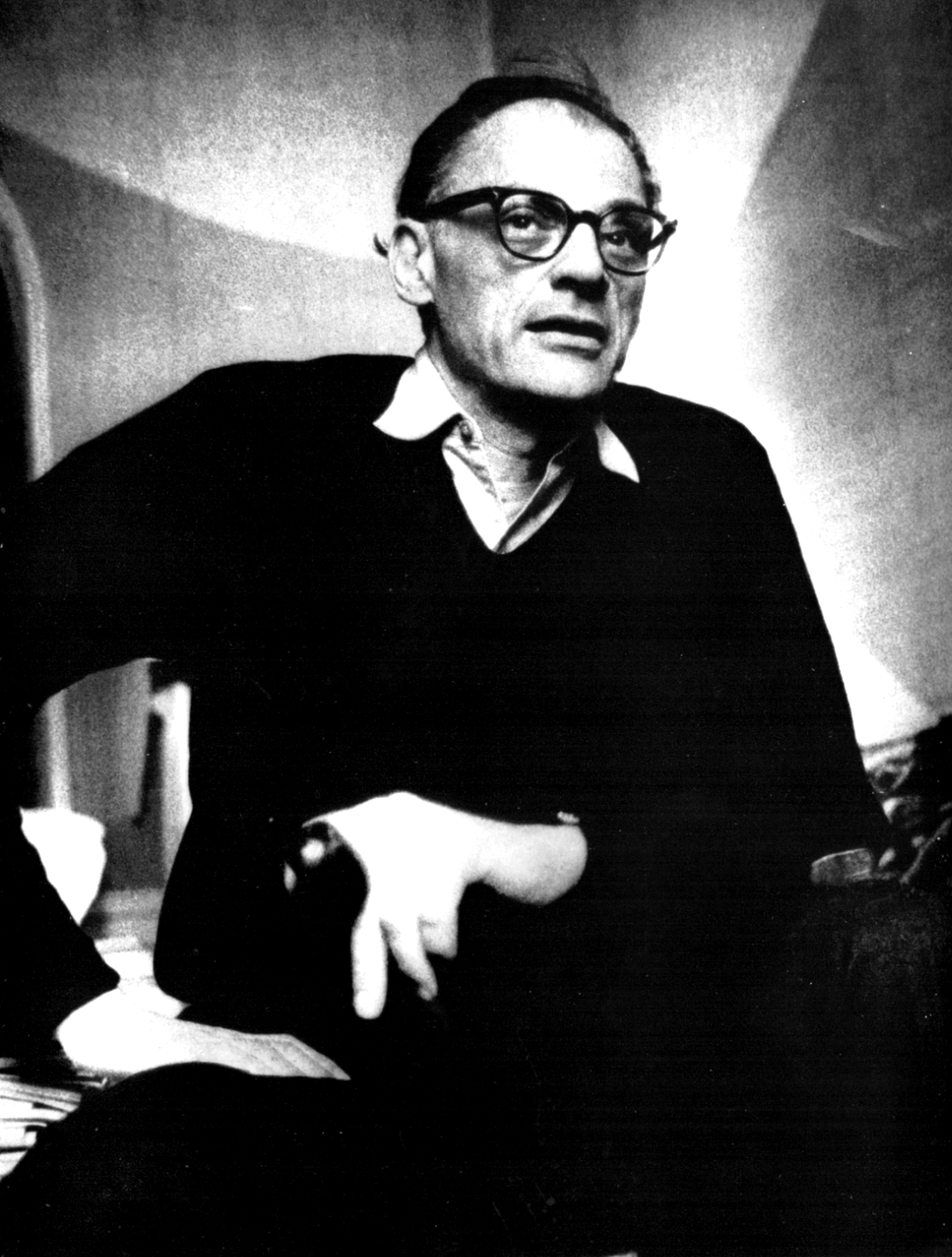
Arthur Miller has been described as the world’s greatest living dramatist. On April 4, for the first time on television, his play, ‘A View From the Bridge’, was transmitted live. It stars Raf Vallone, Katharine Blake and Francesca Annis. Joan Kemp-Welch directs. While in his Paris flat recuperating from an illness Arthur Miller gave a rare, long interview to Ronald Elliott [Editor of ‘Fusion’, the staff magazine of Rediffusion Television — Ed] about his views of the play, of writing and of life. Arthur Miller is no head-in-the-clouds intellectual. He is pleasant, quiet-spoken, quick to laugh, easy to get on with and willing to talk about almost anything. On these pages is a transcript of the interview which is also published in a special booklet produced to mark this television occasion.
elliott: What feeling or thoughts did you want the audience to take away with them after having seen ‘A View’?
miller: Really, what I was after in writing the play, I think, above everything else, was to deal with a person who can’t walk away from certain incidents in his life. I mean, it’s a mark of civilisation that one finally makes certain transactions with indignity. You find some rationalisation for saving yourself or for not doing what you feel you should do and so on. And consequently we get more and more indefinite because the threshold keeps getting higher and higher until we’re blocked off from any action at all. I was trying to find, trying in this story, to deal with somebody who literally creates his own doom to be sure, but whose dynamics are clear and open and we know exactly what’s going to happen, more or less. The whole question is how can one stop this? The lawyer in the play knows exactly what is going to happen, he knows it is going to end in disaster, but it is beyond any human help. I suppose it was an attempt to reach into what civilisation has removed for the most part, and that is the implacable, the thing that goes beyond even necessity. It is almost a blood drive, which would help define the fact that there are such things in the world as human spirit — even as perversely as it is manifested in this play — and honour and so forth. In writing it, by the way — it’s always been interesting to me — I got to understand — even though I never modelled it on anything — I got to understand Shakespeare better because you see in those plays, in a play like ‘Macbeth’, where you ask the same question: ‘Well, why don’t they stop now?’, because Macbeth is full of doubts about the thing, he really senses that it can’t come to any good. It’s almost opposed to part of his nature. And yet it goes on and on to the very bitter end. I think it’s because they were in a different stage of civilisation than we are. We act the same way now, I think, in wars and in political life. That is, you see a situation where a country is manifestly committing one Greek-like tragic mistake after another and you are helpless, the country is helpless.
elliott: That horrid word ‘escalation’?
miller: Yeah, it just goes on and on and on and you say, well, how does one stop it? It’s less obvious perhaps, in individuals any more, although I am not so sure of that either, since 50 per cent of the beds in England and in the United States are occupied by mental illness. Maybe even that isn’t true. But it’s obviously true in international affairs.
elliott: Yes. And this you did in 1954-55. Really it was foreseeing the trend that was coming, because it was not taking place to such a degree then?
miller: No. I had the feeling then, you see, because it was at a time when, for me anyway, it seemed that life had been so covered up by one rationalisation or another that there didn’t seem to be any human nature any more, or so people were trying to convince themselves. I was trying to reach for some vision of a human nature, that is an implacable demand on the part of something in a person, even for destruction, that could not be rationalised away and couldn’t be stopped.
elliott: And this is why, partially why, you used a dock worker as opposed to a don. The man didn’t have the deeper intelligence that would have enabled him to have seen any alternative way out of the situation?
miller: Except that I had not rationalised it to that degree. It happens that this story sprung from a real story that I had heard on the waterfront. But it certainly was more apparent in him. I think we are all in the grip of forces we can’t understand until too late. But it gets covered over by escape mechanisms. We manage, living in comfortable countries, not to face fate as clearly as people do who are less sophisticated about it.
elliott: You picked the story up while you were in the Brooklyn dockyard?
miller: Yes, it was on the water-front in the early ’50s. I never met this man. But I had heard about the tale.
elliott: Where he gave away his Italian cousins?
miller: Yes.
elliott: What started you off was the betrayal?
miller: Yes.
elliott: How would you rank ‘The Bridge’ amongst your plays? It has been said that it is the most skilfully timed of all your plays. What do you feel about this?
miller: Well, to me, they’re different. I don’t know how to compare them. You see, this play is naked. That is, it moves from one crisis to another without any intervening material whatsoever. I wanted to tell this story really the way I had heard it. I mean, if you re-tell this story to someone, you can re-tell it almost like a skeleton and they get a certain effect from it. I didn’t want to lard it over with any kind of decoration. It seemed to me to be such a severe tale to begin with, it would be wrong and it would weaken it if I delayed it, or if I made it more complicated than really it was. So that the other plays build quite differently. They are concealed more in the beginning. They evolve out of a more normal kind of life than this does. It can’t be compared really to the other stuff.
elliott: It’s a direct tale, whereas in your other plays you have woven in, what would you say, the humanities?
miller: You see, in this story, I wanted to tell only those things which had direct and open bearing upon his disaster. In the other plays, an attempt is made to present these people in the round, as though the disaster were merely a part of a much more differentiated kind of life. Here I wanted to go directly to the cause and effect with no intervening material at all, and in that sense it is a little bit like the way that some of the Greek plays are told. If you take Oedipus, you don’t know anything about Oedipus excepting what pertains to him in relation to this particular story. You don’t know whether he is a good father, or a selfish man or an egotist or a frightened person or what. It doesn’t enter the tale for the simple reason that it has no decisive effect upon his fate.
elliott: But you have taken basically simple characters, therefore there is no embellishment on the character level. But there is embellishment on the action level. They are reacting to the situation? What is the key picture you retain from the play?
miller: Well, the image that comes to my mind first is the look Raf Vallone gets sometimes, a mixture of loneliness and terror.
elliott: The title is ‘A View From the Bridge’, now the view from Brooklyn Bridge is the Manhattan skyline?
miller: Well, what I mean by the title is that the bridge passes over the neighbourhood where this takes place which is called Red Hook. There is this traffic going mindlessly by over this place. The bridge, to me, means the comfortable, progressive New York that is busy making all this money and involved in the neuroticisms of the 20th century. Down below is this story taking place which could have taken place 1,000 years ago. The primitive, maybe essential man, is down below and I’m looking out from that bridge where it all looks picturesque with the docks and the ships from all over the world.
elliott: Do you, in the States, watch much tv?
miller: I can’t and I wouldn’t because most of it I think is not worth the time.
elliott: Do you watch it in France?
miller: I haven’t even got a television set here, but we’re only here two or three weeks a year. I’m sick now, so we’re here a little longer. Normally we don’t stay here very long.
elliott: You come over in the spring?
miller: Well, I don’t come regularly, it’s just at odd times. I have never been here in the spring. It’s really in the middle of the winter, which is the worst time to come here. But I like to be at home during the spring. We live in the country.
elliott: You have a farm?
miller: Yeah, it’s more beautiful there than anywhere.
elliott: Where is this farm?
miller: It’s a place called Roxbury, which is in Connecticut, which is 100 miles north of New York City.
elliott: So in the States, if you do watch tv, what type of programmes would you watch?
miller: Well, I’ve found the stuff that I like the best actually is the news coverage. That is, the live, or if it’s not live then taped, on-the-spot coverage — I think it’s superb and unapproachable by any other means. Incomparable is the word. The drama is now beneath talking about. I think the only worth-while thing on television is the news. They’ve got some very first-class people editing the news and commenting on it and so on, as good as anything in the press or a magazine.
elliott: How else do you relax?
miller: Well, I haven’t really got a farm. I’ve got a tree nursery in which I raise young stock and sell it to landscape people and whoever wants to buy them.
elliott: Any specialities?
miller: Well, mostly what we call shade trees — like maple. The difficulty in finding trees is that there are plenty of trees, but when they grow in the woods, they usually grow lop-sided or they have good tops and no bottoms and so on. So they are raised here and cultivated and they grow all around and you can move them easily.
elliott: You have a feeling for trees?
miller: I always have had. I call it a hobby although sometimes it takes a good deal of time to do it, but in general you don’t have to milk them, that’s one good thing. And I enjoy it.
elliott: There is so much indiscriminate cutting down of trees these days — they have taken 50 years to grow and wham! it’s gone.
miller: Well, it’s one of the disasters of civilisation.
elliott: On to a deeper side of television — what do you think about its social effects?
miller: I can’t imagine that it doesn’t have important effects on people, because in industrial states more and more people are being cut off from one another. It’s been happening for a long time. I mean, we no longer live on the front steps of the house, excepting in Italy. In northern Europe and the United States, certainly, we close ourselves into an automobile and move that way, instead of being next to someone on a train or a bus or something of that sort. People then have to look somewhere for an image of themselves. They have to interpret themselves to themselves, and these images are, of course, most widespread on television. So I can’t imagine that it doesn’t have a profound effect, even though it’s almost impossible to say exactly what that effect is. I think that the dreadful failure for the most part is that some kind of depth is not reached in that image, that it is often for the most part so superficial and so childish and shallow. I do know it isn’t easy to do. God knows, it isn’t easy to do on the movies or on the stage either, but it’s a pity that it is not done or it is not attempted more often. I think there’s an audience far larger than anybody imagines.
elliott: One would hope, with education developing, that people’s standards and tastes will rise and they will demand…
miller: Excepting, of course, they don’t demand anything without an example. In other words, most people can’t imagine that the thing can be any different than it is. It’s a given quality, like the weather. They turn it on and that’s what it’s supposed to be. I think there’s a problem too in how one approaches this uplift. I — you spoke of intelligence — I don’t look at it that way, I don’t think that the drama that survives is the drama that appeals to the idealisational part of man. I think that you go to the library or the movie, or the book for that. All the millions of people that appreciate Shakespeare, of all of them, there are very few who can make what one can call an intellectual or intelligent analysis of any of the plays. It’s a tribute to the play, that they go on that way, because they’re appealing to something very fundamental that is probably below that cortex of the brain.
elliott: It’s something instinctive.
miller: Yes, Shakespeare is talking for the most part about the deepest human experiences one can have, and it’s on that basis of approaching people as human rather than customers for a library that any improvement will ever be made, because most of us aren’t thinking most of the time. You are dealing with emotions. You see, what I object to in most drama is that it isn’t dealing with emotions. In a curious perverse way, at least in America, the so-called television drama is based on schemes and sketches of what ought to take place. It is never dealing with what is taking place.
elliott: What people would like to take place?
miller: Yes. If they face what so many artists now especially are aware is taking place. I’m not talking politically, I mean it within the hearts of people. Then they would start to get an audience. I can’t blame people for not looking at so much of the stuff that is called elegant or high-class or something, because it isn’t. It’s just a lot of attitudes which are shared by a small group of indoctrinated people.
elliott: This brings me straight into something else 1 wanted to ask. Do you, as a playwright, in your opinion, reflect or anticipate trends?
miller: That’s a complicated question. I think that some playwrights, like Shaw, possibly quite objectively and knowingly, were doing that. He was up to his neck for at least the first third of his writing career in real political agitation. And I think he was trying wilfully to grab hold of the moment and to shift the direction of the society. And that’s one way to do it. I think for the most part, one senses the way things are, the current level of awareness of life, and one feels that, for one reason or another, it’s missing an essential element which one sees and others don’t.
elliott: But this is a sense — it’s not a reaction to stimuli?
miller: Well, I think it is in a way. Sometimes a play is born from picking up a newspaper and seeing a story. After all, Balzac — who was not a playwright, but is a good example of a writer dealing with his time always — he could pick up the morning paper and two days later come up with a terrific story, or Dostoyevski would do that. From the incident, he would adduce certain truths — the incident itself might be of no importance or little importance — truths of the moment.
elliott: How does it work with you? Do you have your theme or do you have your story?
miller: Most often, I believe it springs out of something that I have — out of mimicry. I can suddenly see a person, the character, with great intimacy, and then probably the rest of my being comes in the play, but not before that. I have to see some central person.
elliott: It’s a person rather than the event?
miller: It is really the person that makes the whole thing spring to life and he drags in with him all the themes and the story and everything else. Until I’ve seen that person nothing very good happens.
elliott: Do you consciously interpret? I mean, if you are reading a newspaper, are you consciously thinking ‘This will provide me with some meat?’ Or does it suddenly come that, hey presto, the next theme will be…?
miller: Well, I wish it were that way, because then I could write a play every two weeks. I often read a paper or a book or hear somebody talking and think ‘My God, what a marvellous play that would make — for somebody else’. Because I can’t see intimately the person involved. I would be writing from the outside. I think the author has to be the expert. He has got to know something that nobody else knows. The trouble with newspapers and my way of writing is that I feel I am on the outside. I feel that somebody else knows this guy much better than I do. I have to have the feeling that I invented this whole business. That somehow or other I am the closest to this individual in the whole world.
elliott: But you use the individual as a means for presenting your theme and your theme is where you foresee a trend?
miller: Yes, well, I wouldn’t put it as a means: that the individual is a means of presenting a theme. The way it occurs to me is that the individual inevitably embodies the meaning of his action. I mean, when I speak of knowing a man, I mean I know a man through something he has done, or through some dilemma he has solved or failed to solve. And it is in the nature of that dilemma that the society, or the moment, is somehow elucidated. Otherwise, it would be of no great interest to me. You see. I am not merely interested in psychology or in cases.
elliott: But you are interested in the human relationships and the human situation as presenting itself today and tomorrow?
miller: Yes, that’s right.
elliott: You have, I think it is possibly true to say, this quote intellectual unquote tag. How do you regard that?
miller: Well, I suppose anybody who goes on writing long enough can be called an intellectual, but it really doesn’t fit me or a good many of the writers I know about in one respect. An intellectual, from my viewpoint, is somebody who is basically and primarily interested in. For example, the history of ideas, in perhaps reducing experience to ideas, to their idealisational substance. I am not intellectual in the sense that I am interested in the raw material first. I can’t write anything from the point of view of the idea.
elliott: It’s the human being – we’re back to that.
miller: That’s right and, therefore, from that view-point, I wouldn’t be an intellectual at all. In a sense, I would be furthest from that imaginable. I’m interested in ideas, certainly. I am interested in psychology and methodology of knowledge, but in the final analysis, writing is a very primitive game and it’s very far from intellectual life. The act of writing, especially plays, has got more to do perhaps with acting, which is certainly not an intellectual occupation. I mean, despite everything, I think that the plays that last any length of time are probably those that have good roles, and I do write good roles, and to write good roles you have to have somehow acted them, somewhere in the centre of your head, you must have faced the problem of acting.
elliott: To carry that through logically, surely one must then also direct it?
miller: Well, it doesn’t follow from this view-point. The actual process of getting an actor to create the kind of aura that you want — you are dealing now no longer with your memory, but with a person who doesn’t share it — so certain buttons have to be pushed on that person which may have very little or nothing at all to do with your image in the slightest. In other words, you get an actor who is extremely good in the loud scenes and has great vocal and personal force, but has no sense of humour and perhaps a sense of humour is needed in three or four other scenes. Well, how do you get a sense of humour out of an actor who really doesn’t have one? You have to create it in him, by sometimes the most devious methods. And that does not follow from the fact that I have imagined this character in the first place. I happen to be pretty good with artists, but I find that it’s better if I sit back and let somebody else direct it and infuse my point of view and keep the play on its tracks. I let somebody else deal with the problem of making a total strange, create what I had originally indicated.
elliott: My point in asking that question is that on ‘The Misfits’, it was said that there were two plays — yours and John Huston’s.
miller: Yeah, well, you see the movie is a different story. It’s different because you not only have to filter through a director, you have got to filter through a producer, cameramen, technicians of 10 or 11 different sorts, and then finally, the actors. So it’s why I have said a writer is a necessary evil in the movie, but he is no longer the author. The director is the author. It’s one of the reasons I don’t like writing movies.
elliott: Yes. yet you’ve just done a screen play, I believe?
miller: Yes.
elliott: This is ‘After the Fall’?
miller: Yes, but it’s not a work I take to very readily.
elliott: Have you found a producer?
miller: It’s in the works now. But you are speaking through a series of megaphones so what comes out finally has a relation to what you had in mind, but that’s about it. The best you can say of a screen play is that it will provide the basic bones of the skeleton, but a camera is so selective that if it is pointed two feet in a different direction than you would imagine, a completely different effect comes over and everything is changed, whereas on the stage, you are dealing through essentially one filter and that is the director. There is one other element and that is the effect of a play is basically through its language. The effect of a movie is through the image, the language is the least important part of it. It hardly matters what actors say, it matters what they do, and you have relatively small control over what is shown.
elliott: You have never wanted more control? You are happy with the situation?
miller: Well, I don’t believe any director worth his pay ought to be an office boy. Otherwise you got no director and you got an author who is not prepared to direct. He’s got — it’s in the nature of the beast — he’s got to take over and consequently the best screen writer is somebody who is more or less content to vanish into the scenery as soon as he has finished.
elliott: An awfully deep question again. I’m afraid. What do you aim to achieve from your plays, from life? What are you aiming to do?
miller: I suppose one of the most wonderful compensations for this racket is to see totally strange people swept up in one’s own fantasy and a few times being profoundly affected by it in their lives. But I think the first part of that sentence is the most important — to see them really join together suddenly and I have always found a quite tremendous kick from that.
elliott: How often do you see one of your plays?
miller: Well, not very often. All I need is once really.
elliott: Once. To know what the reaction is?
miller: If a play’s running very long, I’d go back just to look in for half-an-hour to see whether the actors have forgotten everything they were told or if they have embellished the parts and then I complain to the director or whoever is around. But it’s really the first few times just before the opening that it’s important for me to see it.
elliott: And the reaction which you yourself react to is the one that has some stimulus on the people in that audience?
miller: Yes.
elliott: That they have gone away with a new insight or with new thoughts…?
miller: Well, God knows whether they go away with any new insight, I don’t know about that. But it seems to me that it is important, or at least it’s pleasurable, to watch people become one with one another. The last time I saw a play of mine, aside from the ‘Vichy’ play in Brighton, was in New York not too long before I left. I went to see ‘A View From the Bridge’ downtown in this off-Broadway thing. There the audience is mostly under 28 or 30 years of age. The majority of them are college kids between 20 and 25, who were, after all, kids when this play was written, and who don’t know anything at all about this kind of life. It might just as well have been taking place on the moon as far as most of them were concerned. So they come in to see a drama taking place in Bali as far as their acquaintance with the locale and the kinds of persons in this play is concerned. They come in, sprawled out in these little chairs, being very cool in their contemporary manner, with their long hair. And you can’t tell the boys from the girls. After about 10 minutes, you see that it’s just the superficial part of them that has changed. They are sitting there without blinking an eye, being swept up by the whole thing. It just makes one feel there is a continuity in life, that we are human, and that one generation doesn’t really begin all over again with everything, and that they are a part of one’s history.
elliott: This is terribly basic, isn’t it, because you get the intellectuals analysing your plays right to the last comma. But the audience itself isn’t doing this and you don’t mind?
miller: Thank God it is the audience that decides. You see, they do dispose of works and they do revive other works. You can’t revive a play, at least not for more than a week, unless somebody wants to go see it. And that’s really the tell-tale thing. If it has something to say to succeeding generations, it’s alive and if it doesn’t, no matter how analysed it is, it’s not going to be made alive. The decision is not made, in the theatre at least, by anybody but those people, the anonymous great unwashed who either come in or they don’t come in and it’s perfectly fair. They are harder judges than any intellectual is.
elliott: These plays that we are having these days, the ones without a beginning and without an end…?
miller: I think that there are a lot of anecdotes being written. They are an anecdote, not a play. At least, they should not be confused with another form, which is a play form. I’m able to enjoy some of them, but I very often wonder what would happen if the authors really sat down to work and tried to draw it to a climax. It would help. It would make it more enjoyable.
elliott: There is a dreadful, intellectual reaction. People don’t really know what it is all about. Or they pretend they know what it is about. Or else there are half a dozen interpretations as to what it is about in the first place.
miller: Well, sometimes it is tough to say what something’s about and rightly so, but I think that there is a part of the public which is falling in love with the opaque because it is opaque and because they don’t really want to struggle with life in one form or another.
elliott: But you don’t write the opaque?
miller: I think the object is not to make simple things complicated, but to try to make complicated things comprehensible. I think it’s harder to do.
elliott: Many of your characters are killed or kill themselves. Are you optimistic yourself or are they pessimistic?
miller: Personally, I live in a state of abeyance. I try to do what I can to make the world more optimistic, but there is precious little that one can do. I wouldn’t class myself in either direction. I am kind of an empiricist. I don’t believe that there is any guarantee, for example, that we are not all going to be dead by sudden onslaught of atomic nuclear weapons. I could very easily imagine that happening. On the other hand, I proceed as if it’s not going to happen. I don’t see how you can avoid that. So the whole question of optimism doesn’t work any more. No man in his right mind can say he is optimistic, but on the other hand, it’s no way to live, excepting to say that, well, I’ll go on doing what I’m doing on the presumption that it’s worth the candle.


